
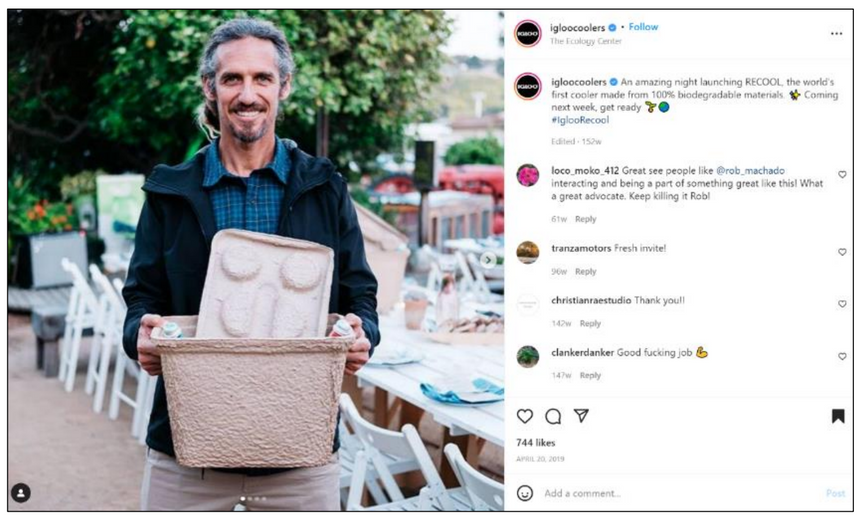
In 2019, Igloo launched the “Recool” cooler, promoting it as “the world's first eco sensitive cooler, made from 100% biodegradable materials.” Here's the problem. Vericool, a competing cooler manufacturer, claims that it released the first biodegradable cooler several years before that. When Igloo refused to withdraw its claims, Vericool sued for false advertising under the Lanham Act. The 9th Circuit just dismissed the case. Here's why.
The Lanham Act provides for a cause of action for false advertising when a competitor “misrepresents the nature, characteristics, qualities, or geographic origin” of a product. Importantly, though, the cause of action must be based on an observable aspect of the product, rather than the ideas or communications that the product embodies or contains.
The issue in this case, then, was whether a false claim to be the “first” is the type of claim that is actionable under the Lanham Act. Here, the 9th Circuit, affirming the decision of the district court, held that it was not. The court explained, “A misrepresentation about attributes embodied in a physical product is actionable under the Lanham Act if it misleads a consumer about the quality of a good itself or misrepresents the physical producer of a good in a manner that would be actionable under traditional claims for unfair competition. If, however, the misrepresentation regards matters that are typically of no consequence to purchasers, such as the source of the idea, design, or innovation embodied in the product, then plaintiffs must bring an intellectual property claim and cannot proceed under the Lanham Act.”
What the court is saying here is that, not only is being “first” not a characteristic of a product actionable under the Lanham Act, but the Lanham Act can't be used to circumvent the limitations on idea ownership provided by the patent laws. (Vericool's California claims were also dismissed by the lower court on similar grounds and were not at issue on appeal.)
Putting aside whether Vericool could have had better luck in this case if it had asserted other state law claims, to me, the big green elephant in the room is whether either company should have been making “biodegradable” claims at all. The FTC's Green Guides say that it's deceptive to make a claim that a product is biodegradable unless the product will completely break down and return to nature within a reasonably short time after customary disposal. And, for products entering the solid waste stream – like presumably these coolers would – advertisers must be able to substantiate that they will completely biodegrade within one year. As far as we know, products that end up in landfills have a nearly impossible time satisfying this standard.
Vericool World v. Igloo Products, 2026 WL 1239879 (9th Cir. 2026).
/Passle/5a0ef6743d9476135040a30c/SearchServiceImages/2026-10-16-16-53-29-106-6ad25689de6b66bfe10fa83e.jpg)
/Passle/5a0ef6743d9476135040a30c/MediaLibrary/Images/2026-10-15-13-20-58-974-6ad0d33a0e7e30becd8d42ec.png)
/Passle/5a0ef6743d9476135040a30c/SearchServiceImages/2026-10-13-21-48-12-516-6acea71cba4fc866bfdc7382.jpg)
/Passle/5a0ef6743d9476135040a30c/SearchServiceImages/2026-10-13-16-47-02-034-6ace60868209d8ca982aa650.jpg)


