
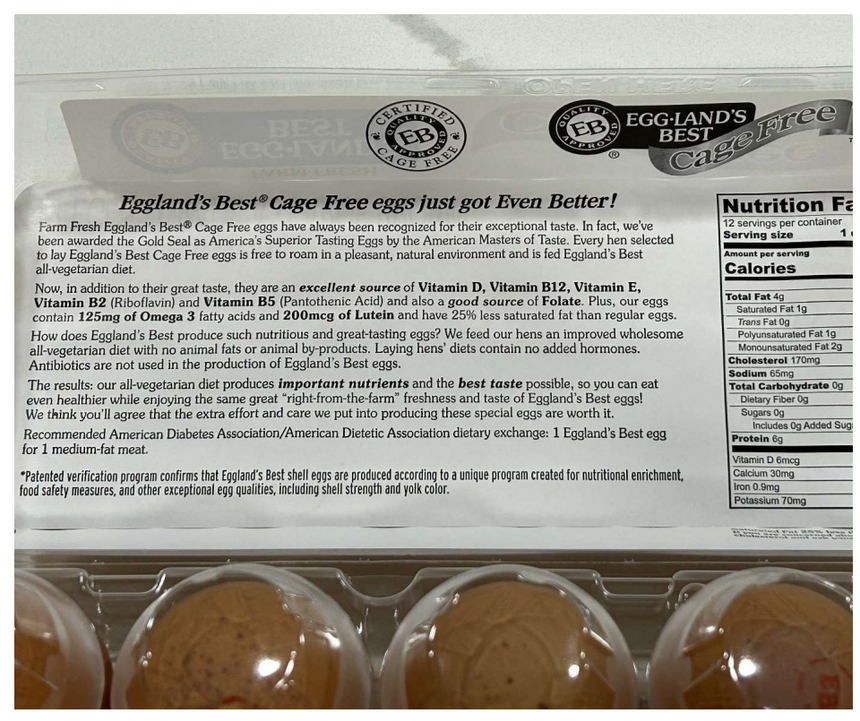
In its marketing for its “cage free” eggs, Eggland's Best promotes the fact that the hens that the produce the eggs are “free to roam in a pleasant, natural environment.” A consumer sued, alleging false advertising and other claims, on the grounds that these hens don't actually have access to the outdoors at all and are, in fact, packed into windowless compounds made of concrete, metal, and dirt.
Eggland's Best moved to dismiss on various grounds, including that reasonable consumers would not be misled by the company's claims. State law “reasonable consumer” standards generally require a probability that a significant portion of the general consuming public (or of targeted consumers), acting reasonably under the circumstances, could be misled. The court denied the motion to dismiss. Here's why.
Eggland's Best argued that reasonable consumers would not be misled because the company is only advertising that the hens are “cage free,” not that they are “free range” or “pasture raised.” Eggland's Best also argued that there's nothing on the packaging that suggests that hens have access to the outdoors. The court didn't buy this argument, however, pointing out that the term “cage free” needed to be read in the context of the other claims that the company made, including “free to roam in a pleasant, natural environment.” The could said that reasonable consumers would understand these statements to communicate that “the hens are free to roam outdoors to some extent, or at least in an environment that is pleasant and natural. At the very least, the consumer would not expect the hens to be kept in packed, metal and concrete facilities, and in unhealthy conditions.”
Eggland's Best also argued that its advertising claims are simply non-actionable puffery. Noting that puffery “encompasses vague, highly subjective, or exaggerated commercial statements or advertisements,” the court found here that the challenged statements were “verifiable facts,” and not puffery. The court explained that Eggland's Best's advertising, “taken as a whole, makes a verifiable promise to the consumer about the living conditions of the hens. While the statement that an environment is ‘pleasant’ alone may amount to puffery, when combined with the promise that hens are, in fact, free to roam in a natural, pleasant environment, it is not the vague and aspirational language that amounts to mere puffery.”
Janecyk v. Eggland's Best, 2026 WL 562066 (N.D. Ill. 2026).
/Passle/5a0ef6743d9476135040a30c/MediaLibrary/Images/2026-10-12-12-11-42-846-6accce7e925119ad2ebd4de3.jpg)
/Passle/5a0ef6743d9476135040a30c/MediaLibrary/Images/2026-10-10-11-51-43-350-6aca26cf8b2b8247488928de.png)

/Passle/5a0ef6743d9476135040a30c/MediaLibrary/Images/2026-10-07-19-09-59-366-6ac69907d24614eebff93c9f.jpg)


