Four hypothetical advertisers use AI in their latest hypothetical campaigns:
- A national bank features an AI-generated performer (not based on a real human) portraying a potential bank customer who describes her banking needs.
- A sporting goods retailer hires human actors to play baseball in the foreground, with AI-generated spectators filling the stadium behind them.
- A perfume company uses AI to depict a well-known celebrity spokesperson floating in the clouds, wearing angel wings.
- A soft drink company’s commercial depicts, in slow motion, its soda pouring into an ice-filled glass, with beads of condensation running down the sides – all generated by AI, with no humans (AI-generated or otherwise) in sight.

Must each of these advertisers disclose to consumers that the imagery in their ads was created with AI? The answer depends on which state’s law applies.
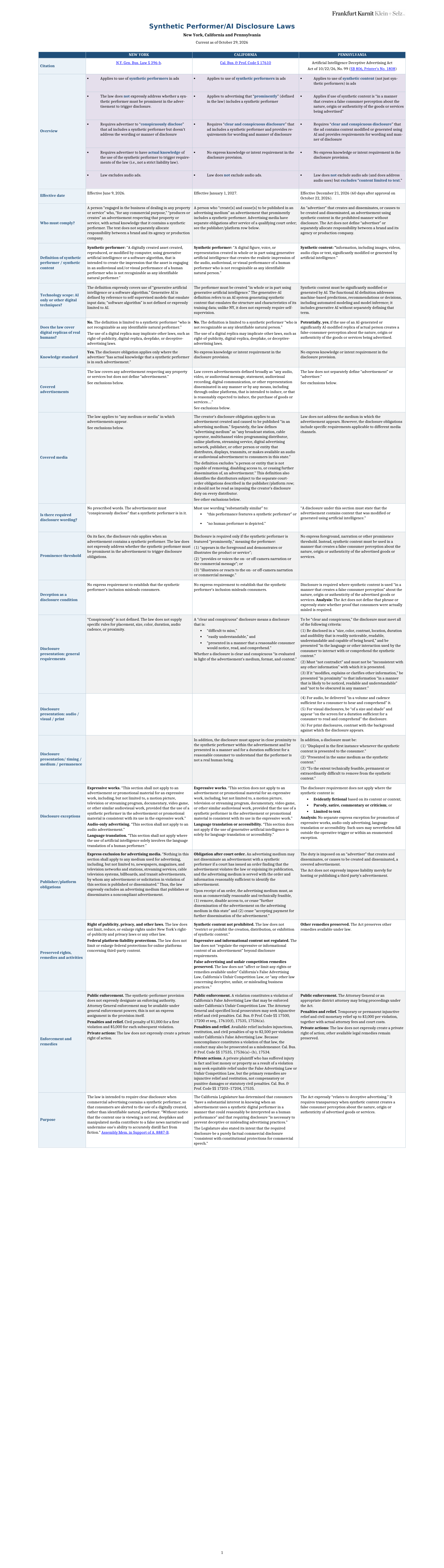
New York, California, and Pennsylvania have enacted disclosure laws addressing synthetic content in advertising, but they take different approaches to when disclosure is required and how disclosure must be made. Enacted within a short period of one another, the laws represent a legislative conversation: New York established a transparency mandate applicable to synthetic performers (digitally created depictions of humans not based on anyone real); California refined that approach by addressing some of the practical questions New York left open; and Pennsylvania shifted the inquiry from the use of synthetic performers to the use of any synthetic content that misleads consumers. These differences not only shape an advertiser’s compliance obligations today, but also could influence the approaches taken by other states that are considering similar legislation.
In this post, I explore several practical questions these new laws raise for advertisers, including how they might apply to the four campaigns described above. The comparison chart at the very end of this post provides a more detailed look at each law’s scope, exemptions, penalties, and scienter requirements.
New York Was First … and Left Some Gaps
New York arrived at the party first, and its law is the only one currently in effect (since June 9, 2026). General Business Law § 396-b, as amended, provides that anyone “engaged in the business of dealing in any property or service” who produces or creates an advertisement “for a commercial purpose,” with actual knowledge that it contains a synthetic performer, must “conspicuously disclose” that fact. Violations may result in civil penalties of $1,000 for a first violation and $5,000 for each subsequent violation. Several months in, advertisers are just beginning to navigate the law without interpretive guidance from the New York AG or, so far, the courts.
Two features deserve attention.
First, on its face, the statute requires disclosure whenever a synthetic performer is “in” an advertisement. Read literally, that language casts a wide net, drawing no distinction between a synthetic “star” delivering the sales pitch and a synthetic extra lurking in the background. It leaves unanswered whether a full human representation is necessary to trigger disclosure or whether AI-generated body parts – such as a synthetic hand holding a product or a synthetic torso modeling a dress – is enough. Nor does the law tie disclosure obligations to a likelihood that the inclusion of a synthetic performer in the ad will confuse, deceive or cause harm to consumers.
It remains to be seen whether the AG will pursue enforcement, and whether courts will find violations, when a synthetic performer appears only fleetingly or has no meaningful effect on consumers’ understanding of the ad or their purchasing decisions. Advertisers may argue that courts should read a materiality requirement into the statute, drawing support from other consumer protection laws. See, e.g., N.Y. Gen. Bus. Law § 350-a (defining false advertising as advertising that “is misleading in a material respect”); Stutman v. Chemical Bank, 95 N.Y.2d 24, 29 (2000) (requiring a showing under N.Y. Gen. Bus. Law § 349 that the challenged act was “misleading in a material way”). They may also invoke the de minimis principle – that the law does not concern itself with trifles – to argue that inconsequential uses of synthetic performers should not give rise to liability. Cf. Ringgold v. Black Ent. Television, Inc., 126 F.3d 70, 74 (2d Cir. 1997) (explaining that, in the copyright context, de minimis “can mean what it means in most legal contexts: a technical violation of a right so trivial that the law will not impose legal consequences”). Courts might agree, or they could view the absence of an express materiality or prominence limitation as a deliberate legislative choice. For now, advertisers cannot assume that brief, background, or otherwise insignificant appearances are exempt.
Second, although the law requires the disclosure to be “conspicuous,” it provides no specific guidance regarding wording, size, placement, or duration. Familiar disclosure principles offer a starting point, but the law leaves advertisers to work out the details for themselves.
California Fills in the Blanks
Cal. Bus. & Prof. Code § 17610 (enacted September 16, 2026, and effective January 1, 2027) follows New York’s basic approach but fills in many of the gaps. It prohibits creating and causing to be published an advertisement that “prominently” includes a synthetic performer without a “clear and conspicuous” disclosure. A violation constitutes false advertising under Section 17500 and is enforceable under California’s Unfair Competition Law, with potential civil penalties of up to $2,500 per violation.
Unlike New York, California requires disclosure only when a synthetic performer appears “prominently,” which occurs if the performer (1) appears in the foreground demonstrating or illustrating a product or service, (2) delivers or voices the commercial message or narration, or (3) illustrates or reacts to the on- or off-camera narration or commercial message. This means that a synth appearing in the background of a scene to create atmosphere – even if clearly visible – probably wouldn’t trigger disclosure, but one holding the advertised beverage, reacting to its taste, or delivering the copy would.
California’s definition of “prominently” will have a familiar ring to anyone who works with the SAG-AFTRA Commercials Contract, the collective bargaining agreement governing the engagement of union actors to appear in audiovisual commercials. Specifically, it tracks portions of the SAG’s definition of “principal performer”— i.e., in everyday terms, performers with a featured role in an ad rather than background extras. The side-by-side comparison below shows the overlap:
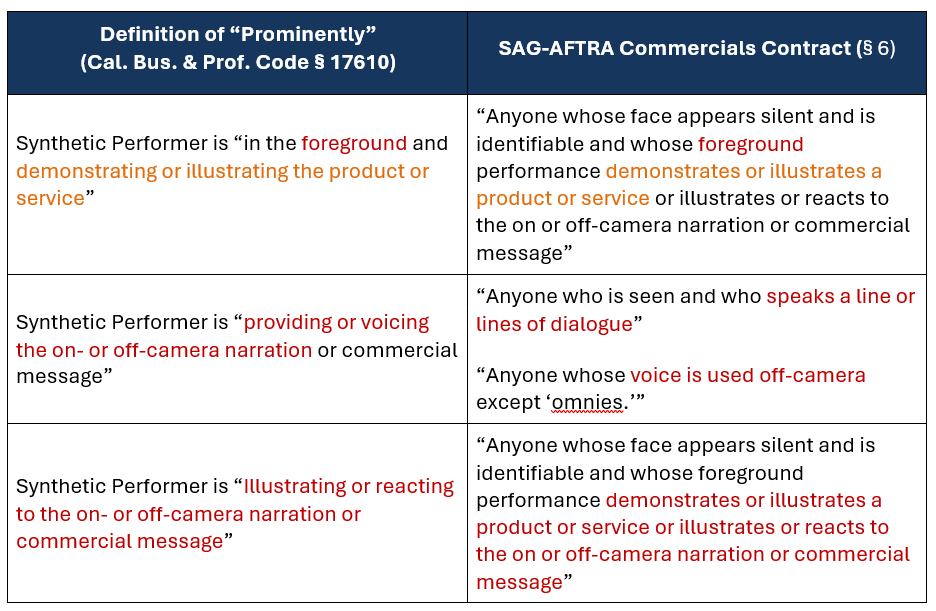
Those echoes are not surprising since SAG-AFTRA sponsored the law and helped shape its language. The statute does not incorporate wholesale the contract’s definition of “principal performer” (which goes on for nearly two pages and has its quirks), and potentially significant differences in their language remain. Nevertheless, courts could look at the SAG-AFTRA Commercials Contract and how its principal-performer provisions have been interpreted for guidance in deciding when a synthetic performer appears “prominently” under the statute.
In addition, California (unlike New York) provides specifications on how to disclose the use of synthetic performers. Its requirements echo familiar FTC disclosure principles: the disclosure must be difficult to miss, easily understandable, and presented so that a reasonable consumer would notice, read, and comprehend it. It must appear close to the synthetic performer and remain visible long enough for consumers to understand that the performer is not a real human being. What is reasonable depends on the medium, format, and context. Clearly, the drafters consulted with an advertising lawyer.
California even goes so far as to require that the disclosure be “substantially similar” to “This performance features a synthetic performer” or “No human performer is depicted.” Those formulations are (IMHO) a bit awkward and, no doubt, will cause consternation among many marketers. Let’s hope that more natural (and, I would argue, user-friendly) alternatives will pass muster, such as “AI-generated model” or “Synthetic performer featured.”
Pennsylvania Shifts Course
Pennsylvania’s Artificial Intelligence Deceptive Advertising Act (signed October 22, 2026, and effective December 21, 2026) prohibits advertisers from creating and disseminating ads that use synthetic content to create a “false consumer perception about the nature, origin, or authenticity of the advertised goods or services” without a “clear and conspicuous” disclosure. The Attorney General or a district attorney may seek injunctive relief and bring a civil action, in which a court may impose a civil fine of up to $3,000 per violation and award actual attorney fees and court costs.
On the one hand, Pennsylvania’s law has a broader focus because it potentially reaches all synthetic content, not just synthetic performers. The definition of “synthetic content” covers information, including images, video, audio, and text, that has been significantly modified or generated by AI. This definition would cover not only synthetic performers but also AI-generated product images and product demonstrations. It would also cover digital replicas –i.e., digital representations of actual humans – which fall outside the definition of synthetic performer under New York and California law.
On the other hand, Pennsylvania’s disclosure requirement is narrower: it applies only if synthetic content creates “a false consumer perception about the nature, origin or authenticity of the goods or services being advertised.” But what qualifies as a false perception? Consider an AI-generated scene showing a cleaner removing a stain. Is disclosure required simply because consumers might mistake the scene for actual footage, even if it accurately depicts the cleaner’s capabilities? Only if the scene purports to show an actual product test? If the synthetic performer using the product says something about its capabilities? Or only if it exaggerates what the cleaner can do? The distinction matters: the law could require transparency about how an ad was made, the authenticity of the experience or demonstration it depicts, or the attributes of the advertised product itself. Whatever the answer, it is critical to keep in mind that disclosure is not a safe harbor for deception. The statute expressly preserves other legal remedies, so an AI label may satisfy its disclosure requirement without curing a misleading demonstration, fabricated testimonial, or unsupported performance claim under other false-advertising laws.
Once disclosure is required, Pennsylvania (similar to California) provides specifications about how it should be made. The disclosure must appear when the synthetic content is first presented, use the same medium, and, to the extent technically feasible, be permanent or extraordinarily difficult to remove from that content. The definition of “clear and conspicuous” adds familiar disclosure principles: adequate size, color, contrast, placement, duration, and audibility; language consumers can understand; proximity to the information being explained; and no contradictory message or obscuring presentation. Audio disclosures must be delivered at a comprehensible volume and cadence, and visual disclosures must remain on screen long enough to be read and understood.
Finally, as noted above, Pennsylvania’s definition of synthetic content is broad enough to cover digital replicas of real people, if their use creates the required false perception about the advertised goods or services. That does not mean every digital replica requires a Pennsylvania disclosure. The celebrity floating through clouds in the perfume commercial may fall within the law’s exception for evidently fictional content. By contrast, a realistic replica presented as footage of the celebrity actually testing a product or reporting personal results is much more likely to trigger disclosure.
How Might the Laws Apply in Practice?
Applying these laws to the four ads described at the beginning of this post shows how differently the three statutes may operate in practice. The chart below offers my assessment under the statutory language.
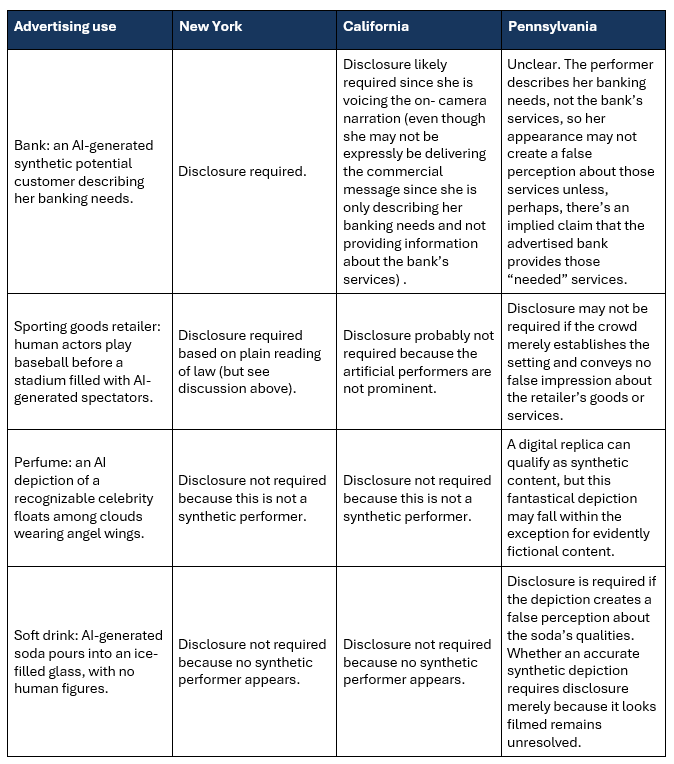
For advertisers planning a national campaign, the struggle is familiar: the creative travels across state lines more easily than the legal analysis does. A single AI-generated scene may raise different disclosure obligations in each state in which the ad appears, leaving advertisers to choose between a uniform disclosure that goes beyond some states’ requirements and separate versions that complicate production and placement.
While we wait for the first enforcement actions, I’m watching how advertisers work these disclosures into their campaigns. Before you know it, “No human performer is depicted” may be as familiar as “Batteries not included” or Professional driver on a closed course. Do not attempt.”