
It’s been a minute since we blogged about embedded videos. (See this post and this one.) The Second Circuit recently gave us a good reason to do so again.
In Richardson v. Townsquare Media, Inc., the court addressed copyright infringement claims arising from embedding social media content in news articles and, in doing so, offered one of the clearest appellate discussions to date of how YouTube’s Terms of Service can, in the right circumstances, operate as a copyright license.
Plaintiff Delray Richardson, a professional videographer, created and owns the copyright in two videos.
- The first is a grainy, 42‑second video in which basketball legend Michael Jordan breaks up a fight. (This may be the video.) Years after it was captured, the video resurfaced when a third party reposted it on X and speculated that the pugilists were a well‑known hip‑hop performer and a YouTube personality. Considering the video and the surrounding controversy to be newsworthy, defendant Townsquare Media embedded the X post (including the Jordan video) in an article featured on XXL, the hip-hop journal of record that it has published for more than a decade. The article also used a screenshot from the video as the visual background for the headline.
- The second video consists of a three‑minute interview featuring rapper Grandmaster Melle Mel, recorded by Richardson and an entity known as The Art of Dialogue. In 2023, The Art of Dialogue posted the video to its YouTube channel under the headline “Eminem Being White Is The Reason He’s A Top 5 Rapper Of All Time. If He Were Black, He’d Be Average!” The following week, Townsquare embedded the Melle Mel interview video in two different XXL articles: the first about the controversial content of the interview, and the second covering rapper 50 Cent’s spirited response to it (in defense of Eminem, naturally). Each article also included a screenshot from the interview video as the headline image.
Richardson sued for copyright infringement based on Townsquare’s use of the Jordan video, the Melle Mel interview video, and screenshots from both. The district court granted the defendant’s motion for judgment on the pleadings, dismissing all claims. The Second Circuit reversed in part and affirmed in part.
Will the Second Circuit Embrace the Server Test?
At the outset, the Second Circuit did not resolve an important issue: whether embedding implicates the exclusive right to reproduce, publicly display and/or publicly perform a copyrighted work under the Copyright Act.
Embedding is a process by which one website (here, Townsquare’s XXL) incorporates content hosted on a third‑party platform (here, YouTube) by using HTML embed code, rather than uploading or storing the content on its own server. When a user visits a webpage containing embedded content, the user’s browser retrieves that content directly from the third‑party platform’s server and displays it within the embedding website's page. Although the content appears to reside on the embedding website, it remains hosted from the third‑party platform’s server. As a result, no copy on the content is stored on the embedding website’s server.
Whether the act of embedding a copyrighted work, as a matter of law, infringes upon the copyright owner's rights remains unsettled. Some courts (mostly, but not entirely, in the Ninth Circuit) have adopted the so-called “server test,” holding that there is no infringement when a website merely embeds content hosted on a third party's server because no copying occurs. (See Perfect 10 v. Amazon (9th Cir. 2007) and its progeny; see also Flava Works, Inc. v. Gunter (7th Cir. 2012).) Other courts (including several district courts in the Second Circuit) have questioned or outright rejected the server test. (See, e.g., Level 12 Prods. v. Mediaite (S.D.N.Y. 2025) and Goldman v. Breitbart News Network (S.D.N.Y. 2018).)
Townsquare did not advance arguments based on the server test, perhaps reflecting a concern that, as of late, the server test has been getting side‑eyed more than embraced in the Southern District of New York. Instead, Townsquare and the court assumed arguendo that embedding constituted actionable copying, display, and/or performance. As a result, we must wait for another day to find out whether the Second Circuit will adopt or reject the server test.
Licensing Via YouTube’s Terms of Service and Platform Policies
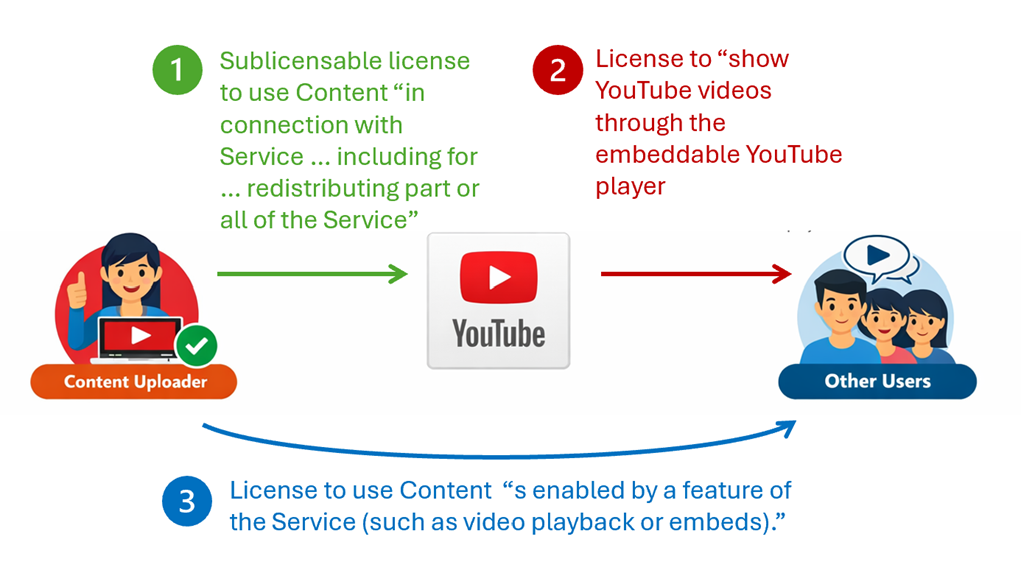
YouTube’s terms of service and platform policies (the “Terms”), like those for every other social media channel, constitute a permission infrastructure upon which the platform is built. In a nutshell, YouTube users grant broad, sublicensable licenses to YouTube to exploit the content they upload in various ways; YouTube, in turn, grants downstream licenses to third parties that wish to display and perform that content (for example, in apps, on news websites, or in social media posts). Without these licenses, YouTube could not function.
The Second Circuit affirmed the district court’s conclusion that YouTube’s Terms expressly authorized Townsquare to embed the Melle Mel interview video in its XXL article, and that Townsquare’s use therefore did not infringing. To reach that result, the court walked step‑by‑step through several provisions of the Terms.
STEP ONE: A user who uploads content grants YouTube a broad, sublicensable license to use the content “in connection with the Service” (i.e., YouTube):
“By providing Content to the Service, you grant to YouTube a worldwide, non-exclusive, royalty-free, sublicensable and transferable license to use that Content (including to reproduce, distribute, prepare derivative works, display and perform it) in connection with the Service and YouTube’s (and its successors’ and Affiliates’) business, including for the purpose of promoting and redistributing part or all of the Service.”
STEP TWO: As part of the Service, YouTube grants users – effectively as sublicensees of the content owner – the right to “show YouTube videos through the embeddable YouTube player.”
STEP THREE: Each content uploader also grants to “each other user” of the Service a direct license to access that content through the Service, including through embeds:
“You also grant each other user of the Service a worldwide, non-exclusive, royalty-free license to access your Content through the Service, and to use that Content, including to reproduce, distribute, prepare derivative works, display, and perform it, only as enabled by a feature of the Service (such as video playback or embeds). For clarity, this license does not grant any rights or permissions for a user to make use of your Content independent of the Service.”
Reading these provisions together, the court held that the Terms were “clear”: by uploading the Melle Mel interview video to YouTube, The Art of Dialog had granted permission to YouTube, as well as to Townsquare, to access the video via YouTube’s embedding functionality. As the court put it, “both the license and sublicense included the ability to republish the video from YouTube by means of embedding.” Townsquare did not allege that The Art of Dialog posted the video without its authorization. Accordingly, Townsquare fell comfortably within the scope of those licenses. And because a copyright owner who grants a nonexclusive license waives the right to sue the licensee for copyright infringement, the Second Circuit affirmed dismissal of the copyright claim arising from the embedded Melle Mel interview video.
Richardson tried to convince the court that judgment on the pleadings was not appropriate because the Terms were ambiguous and contradictory. Specifically, he argued that a provision in YouTube’s API Terms that prohibits embed users from infringing upon third party rights “implied” that Townsquare was obligated to secure permission directly from the copyright holder in order to embed content outside of YouTube’s platform. The Second Circuit rejected the argument. Construing the API Terms to require additional consent would render YouTube’s express embed license meaningless, a result disfavored under California contract law, which governed the Terms.
Finally, Richardson argued that judgment on the pleadings was not appropriate because there were factual disputes regarding Townsquare’s compliance with specific platform policies governing the use of the embedding functionality, including (among others), the prohibition on using the embedding functionality for commercial purposes. The court found that these contractual requirements amounted to covenants only and were not conditions. This distinction is critical (as we have written about before), as the court explained:
“In evaluating claims for copyright infringement where there exists an underlying licensing agreement, we refer to contractual terms that limit a license’s scope as ‘conditions,’ the breach of which constitutes copyright infringement. We refer to all other license terms as ‘covenants,’ the breach of which is actionable only under state contract law.” (Cleaned up, citations omitted.)
Only contractual terms that limit the scope of a license – true conditions precedent – give rise to copyright infringement if breached. The court concluded that the obligations at issue here are covenants enforceable (if at all) only by YouTube. Even if Townsquare violated those obligations, that would not retroactively convert an authorized embed into copyright infringement. The YouTube license stood.
One additional observation: Townsquare did not argue that its embedding of the Jordan video was permitted based on the permission infrastructure of X. The likely explanation is that the person who uploaded the video on X did so without permission from Richardson. If the uploader lacked authorization to post the video, then X acquired no rights and therefore could sublicense none to Townsquare. The chain of title collapsed at the first link.
De Minimis: One Frame Can Be Enough
The district court had dismissed Richardson's claims that Townsquare's use of the screen shots was infringing under the de minimis doctrine, reasoning that a single video frame is only a tiny fraction of a longer audiovisual work. The Second Circuit emphatically rejected that reasoning.
As the court explained, de minimis analysis is not just about how much was taken in the abstract: it also turns on observability, focus, and prominence of the copyrighted work at issue. Here, the screenshots were not fleeting background elements; they were intentionally selected, prominently displayed, and used as headline images to signal the subject matter of the articles. In short, they were meant to be seen and recognized. (See this post.)
The court also noted the tension between the district court’s reasoning and the Copyright Act itself, which grants exclusive rights in “individual images” of an audiovisual work. See 17 U.S.C. § 106(5) (right to publicly display extends to “individual images of a motion picture or other audiovisual work”). Townsquare reproduced the entire copyrighted work insofar as each screenshot was concerned, not a trivial fragment.
Fair Use: Not on the Pleadings
Finally, the Second Circuit reversed the dismissal of the Jordan video claim on fair use grounds, holding that fair use could not be decided at the pleading stage on this record. Here’s a quick rundown of the court’s analysis of the statutory factors. (17 U.S.C. § 107.)
- Purpose and Character of Use. The first factor weighed against fair use. Even though the article had some news value, the court was skeptical that embedding the entire 42‑second video – with only a “modicum” of commentary – was sufficiently transformative to justify wholesale copying. Townsquare’s reporting “at times appears more focused on the mere existence and presentation of the video itself,” as evidenced by the article’s headline which “presents the video as the article’s primary draw” by inviting readers to “watch” it. These facts strongly suggest that “the video may have retained its original purpose and character in the new packaging of Townsquare’s website.” Indeed, the court quipped “there is a difference between gesturing towards a transformative message and actually communicating that message.”
- Nature of the Copyrighted Work. This factor tilted in favor of fair use because the Jordan video was “largely factual” and did not involve meaningful creative choices. “That Richardson was fortunate to be in the right place at the right time to record Jordan’s unexpected intervention does not make the work creative." (I know some photographers who would take issue with that statement!)
- Amount and Substantiality of Portion Used. The use of the video in its entirety weighed against a finding of fair use. The court didn’t buy the defendants’ argument that use of the whole video was necessary to report accurately on the controversy: other options were available to Townsquare, such as quoting or paraphrasing the content of the social post, using only a still image or short clip from the video, and linking out to the post rather than embedding it (and the video) in the article.
- Effect on Potential Market/Value of the Work. The final factor weighed against fair use. The danger of market substitution looms large here, since it was entirely plausible that consumers who watch the full Jordan video for free on Townsquare’s site would have no reason to go find it from Richardson. As the court put it, Townsquare’s republication of the entire video “potentially provided consumers with a substitute work that obviated the need to seek out (and pay for) the video from Richardson.”
So, more than half the case survives, with further proceedings to be conducted on remand.
Richardson v. Townsquare Media, Inc., No. 25-291 (2nd Cir. Apr. 23, 2026).
/Passle/5a0ef6743d9476135040a30c/MediaLibrary/Images/2026-10-15-13-20-58-974-6ad0d33a0e7e30becd8d42ec.png)
/Passle/5a0ef6743d9476135040a30c/SearchServiceImages/2026-10-13-21-48-12-516-6acea71cba4fc866bfdc7382.jpg)
/Passle/5a0ef6743d9476135040a30c/SearchServiceImages/2026-10-13-16-47-02-034-6ace60868209d8ca982aa650.jpg)
/Passle/5a0ef6743d9476135040a30c/MediaLibrary/Images/2026-10-13-16-02-21-239-6ace560da1503fba13b751b8.png)


