
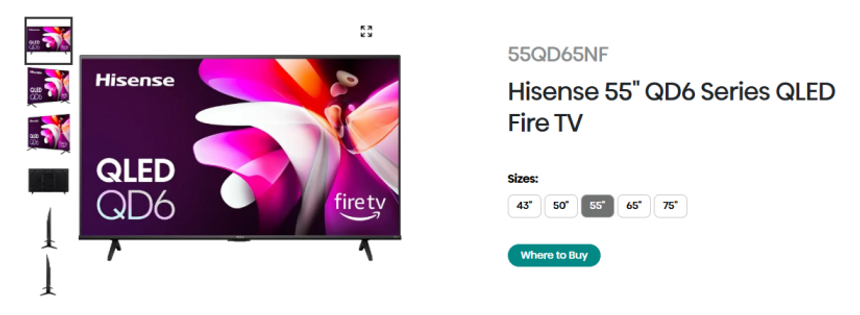
Hisense USA sells QLED televisions. As Hisense explains on its website, “With Hi-QLED Color delivering vivid color, every scene feels richer, deeper and more lifelike – whether you're watching a late-night drama or a weekend blockbuster.” According to Consumer Reports, a QLED television is an LCD television that uses quantum dots to produce better colors.
Some consumers sued Hisense for false advertising, alleging that Hisense misled consumers in its promotion of its QLED televisions through third-party retailers, because the TVs either do not contain QLED technology or they contain such negligible amounts of the technology that it won't meaningfully contribute to the television's performance.
Hisense moved to dismiss, arguing that the consumers' allegations were speculative and unsupported. The court allowed the case to proceed, holding that the evidence submitted by the plaintiffs at this stage of the proceeding was sufficient to allow the case to continue. As the court explained, “considering all of plaintiffs' allegations – including the references to the Rtings.com articles, industry standards, and their own testing – plaintiffs have plausibly alleged that the Hisense TVs at issue either do not contain quantum dot technology or contain it in negligible amounts such that it does not provide the advertised benefits of a true QLED TV.”
While this lawsuit is still at its very early stages, and there's no telling how it will resolved, it highlights some important issues that advertisers should think about when advertising new technology.
First, when new technologies get introduced, consumers are often less familiar with them. As a result, they may not fully understand the technology being promoted or the specific benefits they are going to get from that technology. In order to prevent consumers from being misled, then, it's often necessary to take extra steps in the advertising to educate them about that technology and how it works and what the limitations are.
Second, with new technology, there often isn't a common understanding about what the terminology means. If you're using newer terminology to promote a product, don't assume that your definition is the same as what a consumer's definition may be. When in doubt, explain exactly what you mean when using an unfamiliar term.
Third, don't ignore the claims your third-party retailers are making. If you're promoting your product through retailers, consider how they are going to promote your product as well. If you've decided that certain qualifying information is needed to prevent consumers from being misled, you're going to want to ensure that the retailers include that information as well.
Finally, this lawsuit raises an important issue about materiality. If you're going to promote that your product has a specific feature, or a particular ingredient, you should consider whether that feature or ingredient is actually providing a material benefit to consumers. If it isn't, consumers may argue that they were misled.
Abi-Chahine v. Hisense USA, No. 25-cv-09960-WHO (N.D. Cal. July 16, 2026).
/Passle/5a0ef6743d9476135040a30c/MediaLibrary/Images/2026-10-10-11-51-43-350-6aca26cf8b2b8247488928de.png)

/Passle/5a0ef6743d9476135040a30c/MediaLibrary/Images/2026-10-07-19-09-59-366-6ac69907d24614eebff93c9f.jpg)
/Passle/5a0ef6743d9476135040a30c/SearchServiceImages/2026-09-25-18-59-25-213-6ab6c48d946b38ce807ecc26.jpg)


