
Members of Safeway's rewards program – Safeway for U – get members-only prices on various products offered for sale in the store. The program is free; in order to get the discount, consumers just need to use their account number when checking out.
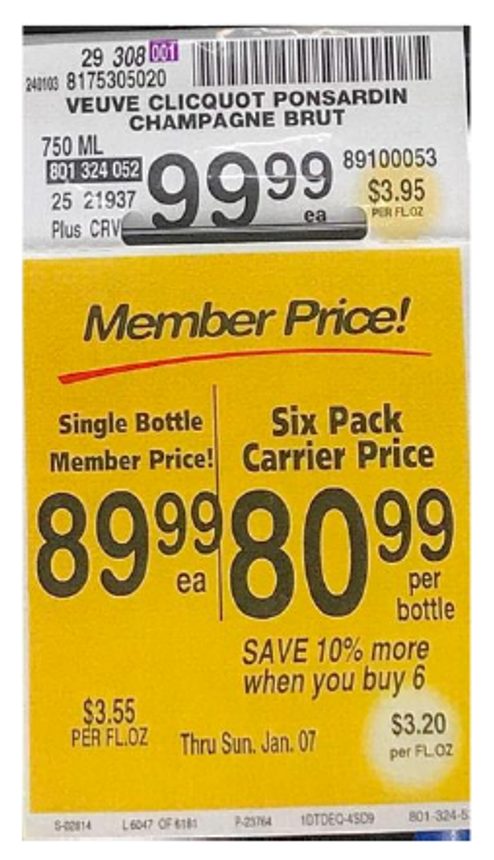
A group of Safeway's rewards program members sued the company, asserting various claims under California law – alleging that its member pricing is deceptive. The core of the consumers' complaint is that it is deceptive to promote the members-only prices as special, sale prices, since they are available, for free, to all members. The plaintiffs alleged that, “Safeway prominently displays the reference price in black and white, with the sale price highlighted below in red and yellow with an end date for the supposed sale, to create the impression that the reference price is the usual price and the sale price is a special offer.” The plaintiffs also alleged that Safeway “intentionally inflates the reference price on the shelf” and then sells its product at purported discount prices, even though consumers aren't really getting a discount.
Considering the plaintiffs' false advertising claim, the court used the “reasonable consumer” test, asking whether “members of the public are likely to be deceived.”
The court didn't buy the plaintiffs' argument that Safeway was artificially inflating its non-member pricing. The court thought that the plaintiff hadn't sufficiently alleged how those prices were inflated or what the actual market prices of the product were. Moreover, the court found that “the higher non-member prices are indisputably real prices charged to non-members.” It's not clear from the opinion what that conclusion is based on; the court didn't explain, for example, what percentage of sales happen at the non-member price.
But, even more generally, the court didn't appear at all troubled by the fact that members could always get the product at a lower price.
The plaintiffs had also alleged that the member pricing was deceptive because it was promoted as a limited-time offer, but in fact, “immediately after each purportedly time-limited sale ends, Safeway generates another similar or identical discount with a new expiration date.” The court doesn't address this issue (perhaps because it had already dismissed the case on other grounds). But, looking at the shelf-pricing, the court may have thought that the mere mention of a date though which a a price is valid didn't actually communicate that this was a special, limited-time offer.
The plaintiffs raised some challenging issues here that, ultimately, the court didn't address all that clearly. The decision should give some comfort to advertisers, though, that, at least to this court, offering always-on, members-only pricing isn't, by itself, a deceptive practice.
Tempest v. Safeway, 2025 WL 3171581 (N.D. Cal 2025).
/Passle/5a0ef6743d9476135040a30c/MediaLibrary/Images/2026-10-07-19-09-59-366-6ac69907d24614eebff93c9f.jpg)
/Passle/5a0ef6743d9476135040a30c/SearchServiceImages/2026-09-25-18-59-25-213-6ab6c48d946b38ce807ecc26.jpg)
/Passle/5a0ef6743d9476135040a30c/MediaLibrary/Images/2026-09-24-23-14-09-614-6ab5aec1d83cff113663c7c0.png)
/Passle/5a0ef6743d9476135040a30c/SearchServiceImages/2026-09-21-19-31-37-460-6ab18619ba6cdd81f3059ee8.jpg)


